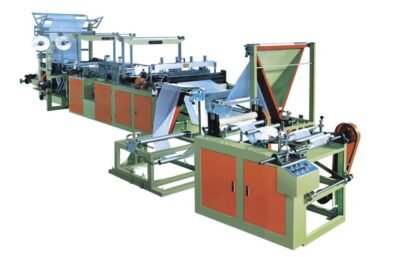
How to Redesign Your Bag Making Machine to Survive the Nigerian Technical Shortage
If you visit plastic factories across Lagos, Ibadan, or Kano, you will see a very common and painful scene. A beautiful, high-speed bag making machine sitting completely idle in the corner of a workshop, covered in dust. The owner is usually stuck waiting weeks for a specialized servo driver or a proprietary PLC module to arrive from overseas. In Nigeria, relying on high-tech automation is a massive gamble because the local engineering pool lacks the training to handle complex systems. When an advanced machine throws an error code, local technicians often use trial-and-error methods that end up burning out other sensitive components. To stay profitable, you do not need a lecture about buying more spare parts; you need a bag making machine that is intentionally engineered to be low-maintenance and easily repairable by local mechanics.
The Mechanical Clutch Alternative for High-Speed Bag Making Machine Systems
The most vulnerable part of any modern automatic bag making machine operating in West Africa is the electronic servo system. While servo motors offer extreme precision, they are highly sensitive to voltage fluctuations and require specialized programming when replaced. A much more reliable solution for the local market is replacing the delicate electronic feeding system with a heavy-duty mechanical clutch and eccentric linkage system. By using a traditional mechanical eccentric wheel to control the feeding length, you eliminate the need for a servo driver entirely. If the bag length needs adjustment, the operator simply turns a mechanical screw, an old-school method that every local mechanic in Nigeria understands how to service using standard garage tools.
Replacing Proprietary PLCs with Analog Relay Control Logic
Many machinery manufacturers install locked, proprietary PLC computer boards into their equipment, forcing you to rely on their software support forever. When these microprocessors fail due to factory heat or dust, your entire plastic bag making machine becomes a useless piece of iron. The real engineering solution for harsh environments is bypassing the PLC entirely and rebuilding the control circuit using analog relay logic. By utilizing heavy-duty electromagnetic relays and standard digital temperature controllers instead of an integrated computer panel, you create a transparent electrical system. If a heating controller or a relay burns out, your operator can walk right into the local Alaba market, buy a standard generic replacement for a few Nairas, and wire it back in within ten minutes.
Modifying the Photocell Eye to Run on Generic Proximity Sensors
The color mark registration tracking system, or the photocell eye, is another frequent point of failure on any T-shirt bag making machine processing printed films. High-end optical sensors are incredibly sensitive to the airborne plastic dust and smoke generated in recycling factories, leading to constant skipping and bag-length errors. Instead of using delicate fiber-optic eyes that require precise calibration, a smart factory conversion involves switching to rugged magnetic proximity sensors or heavy-duty mechanical limit switches for non-printed bags. For factories that must run printed materials, we modify the heat sealing bag making machine to use an oversized, low-resolution analog photo-eye with an external sensitivity knob, allowing uneducated operators to manually adjust the tracking tolerance without accessing complex software menus.
Decoupling the Integrated Drive System into Modular Components
Standard modern equipment often features integrated multi-axis drive boards where one single short-circuit destroys the controls for the sealer, the cutter, and the feeder simultaneously. For a side sealing bag making machine destined for the West African market, the ultimate design solution is complete modular decoupling. This means assigning an entirely independent, off-the-shelf inverter to every single motor on the chassis. If the pulling motor inverter fails, the cutting motor inverter keeps working, and you only need to swap out one cheap, generic component. At our manufacturing facility, we specialize in building these heavily customized, modular, and mechanically driven units because we know that simplicity, not complex technology, is what keeps a heavy-duty bag making machine running profitably in Nigeria.